
Custom Perfume From a Brief: Nine Steps to a Gift-Ready Range
A custom perfume project has a short middle and a long tail: the brief and the first sample round happen quickly, and almost everything else is refinement, testing and packaging that the buyer did not picture when the brief was written. Working from a brief to a gift-ready range in nine steps, the stages that consume the calendar are rarely the stages that consume the imagination. Knowing the sequence in advance is what allows a team to give a custom perfume manufacturer the information it needs at the moment it needs it, instead of discovering the requirement one round later.
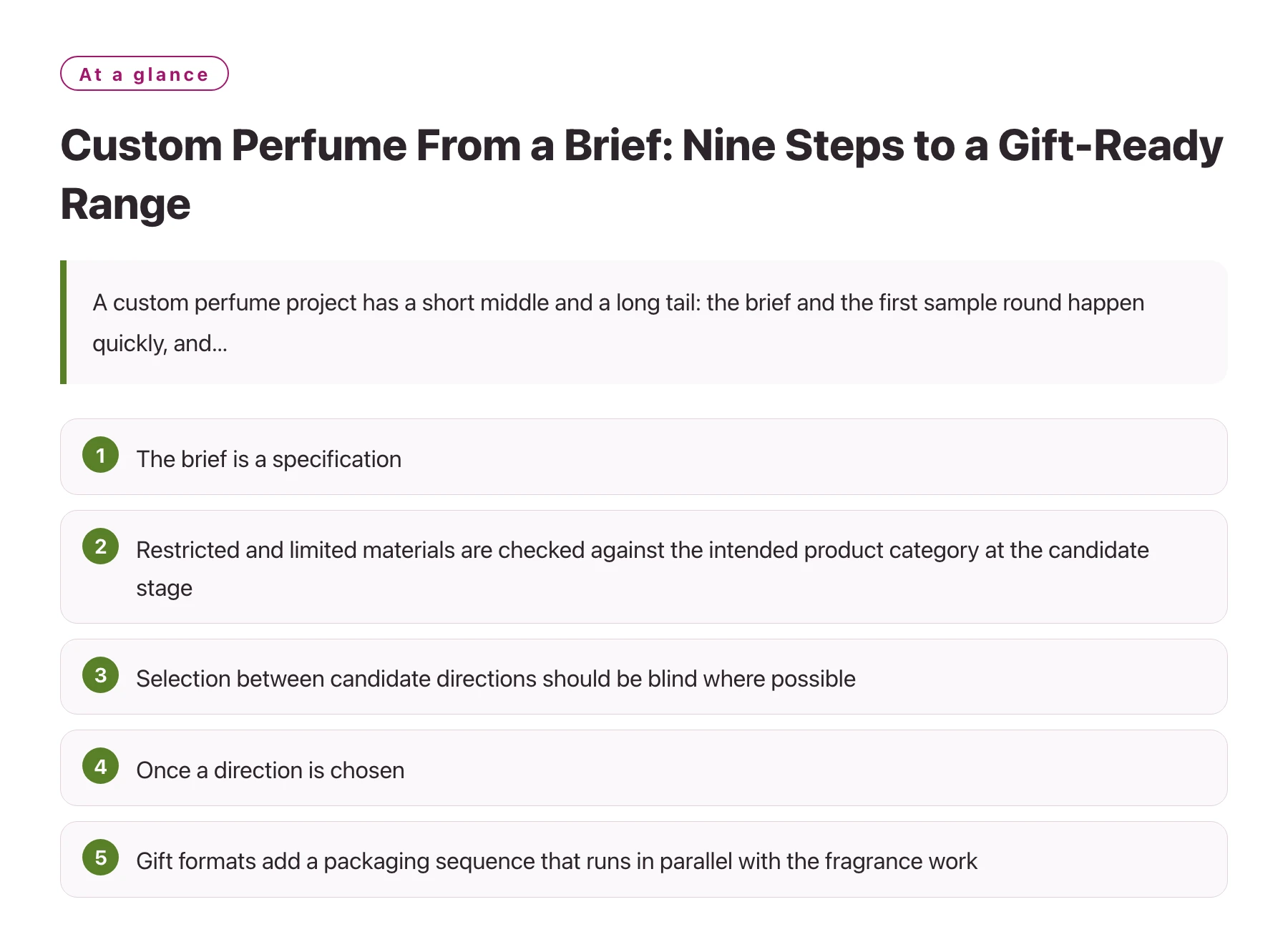
Key takeawaysThe brief is a specification, not a mood board: it should name the product formats, the market, the price ceiling, the volume and the ship date before any sample is mixed. · Restricted and limited materials are checked against the intended product category at the candidate stage, which is why an early conversation about the intended use saves a reformulation later [1]. · Selection between candidate directions should be blind where possible, because a label, a story or a price changes how a scent is judged. · Once a direction is chosen, the work shifts from creation to repetition: matching reference standards, filling trials and stability checks are what make the scent survive a repeat order. · Gift formats add a packaging sequence that runs in parallel with the fragrance work, and a festive gifting range only ships on time when decoration and insert approvals are planned as critical path items rather than as follow-up tasks. · Compatibility and stability testing belongs to development rather than to pre-shipment, and commissioning it from a laboratory with a published scope makes the result easier to carry into another market [2].
Most first-time buyers imagine a custom perfume project as a conversation followed by a bottle. What actually happens is closer to a relay: the brief, then candidate directions, then a selection round, then refinement against the products the scent will live in, then testing, then packaging, then production. Each stage hands off to the next, and each handoff has an input the brand must supply.
That structure is why two projects with identical briefs can differ by weeks. The variable is not creativity; it is how completely each handoff was prepared before it happened. A brand that arrives with the market, the format list, the volume and the deadline already settled moves through the early stages quickly and spends its time where it matters, on choosing between real options.
This is the sequence as a product developer experiences it, with the decision attached to each step and the point at which the step can quietly go wrong.
Nine steps from a written brief to a gift-ready range
- Write the brief as a specificationName the formats the scent must work in, the market it will be sold in, the retail price band, the first-order volume and the ship date. A brief without those five items will produce samples that cannot be converted into a plan.
- Agree how many development directions the fee coversCustom development is sold in rounds, so the count, the cost of exceeding it and the definition of a completed direction should all be settled before the first trial.
- Screen candidate materials against the intended categoryThe same composition can be acceptable in one product type and constrained in another, so the category has to be stated before candidates are proposed rather than after one has been chosen [1].
- Run the selection round blindEvaluate candidates in matched containers with coded labels and no pricing in front of the reviewers, then repeat the comparison a second day before committing.
- Refine the chosen direction against every baseA scent that works in an eau de parfum may behave differently in a lotion, a hand wash or a candle, and this is where the range either holds together or splits into two formulas.
- Commission compatibility and stability workTest the scent in each product and pack combination, hold the samples under defined conditions, and keep the reports, because they become the evidence base for reorders and for later market entries [2].
- Specify the bottle, closure and decorationFill volume, pump or cap type, decoration method and the approved decorated sample all have to be fixed before gift assembly can be scheduled.
- Build the gift presentation around the packOuter box, insert and any sleeve or ribbon are developed after the primary pack is settled, never in parallel with it, because the insert dimensions depend on the final bottle and cap.
- Approve the reference and release productionThe retained reference from the approved batch is what later orders are compared against, so signing it off is the step that converts a project into a repeatable product.
Where the sequence usually slips
The steps themselves are not complicated; the friction comes from treating a later step as though it were independent. Packaging is the clearest example. Gift formats look like a finishing touch on a fragrance project, but the outer box and insert are physical objects that fit the bottle, and the bottle cannot be finalised until decoration and closure are chosen. A festive gifting range planned in that order stays on schedule. One planned with packaging left until the scent is approved tends to lose the weeks it saved.
The same pattern appears in testing. Compatibility and stability work produces answers that feed the specification, the label and sometimes the formula itself, so it belongs early in the sequence rather than at the end. When it is deferred, a brand can end up with an approved scent, an approved pack and an unresolved question about how the two behave together over time.
The brief is the cheapest document to change
A change to the brief costs a conversation. The same change after the first sample round costs a development round, and after packaging approval it costs artwork, tooling and time. This is the argument for writing the brief slowly and completely, covering price band, volume, markets and formats even when some of those numbers are still estimates.
Estimates are acceptable. What matters is that the assumptions are visible, so the development partner can say which of them changes the recommendation. A brand that states a plausible first-order volume and marks it as provisional gets more useful advice than one that leaves volume out of the conversation.
What the brand owns at each step
Ownership is decided progressively. Candidate directions belong to the developer until the contract says otherwise; the selected composition is what the rights conversation is usually about; artwork and packaging drawings are separate assets again. For anyone working with a custom perfume manufacturer, it is worth noting in the project file which deliverable was received at the end of each step, because that list becomes the handover checklist if the relationship changes.
Brands that build a private label range rather than a bespoke one follow the same sequence with one difference: the scent is selected from an existing library, so steps two to six collapse into a selection and a compatibility check. That shortcut is real, and it is why private label fragrance production moves faster than full custom development while still requiring the same packaging and testing discipline.
Teams that are new to the category often benefit from orientation material produced by the industry's own organisations before they brief anyone; the Fragrance Foundation, for example, is a non-profit whose public material covers the trade and its education programmes [3].
If only one habit is carried into the next project, make it this: end every step with a written record of what was approved and what was received. The nine steps are stable, but the handoffs between them are where a festive gifting range loses its ship date. A one-page log per step costs an hour across the whole project and removes almost all of the ambiguity that otherwise reappears during production. It is also the document that makes perfume manufacturing process discussions concrete rather than theoretical when a supplier asks what has already been settled.
Sources
- IFRA Standards Library (International Fragrance Association) —— The IFRA Standards Library lists the restrictions the fragrance industry applies to individual fragrance ingredients, based on safety assessments; it is the reference point for compliant fragrance formulation.
- SGS: Cosmetics, Personal Care & Household Testing —— Testing, inspection and certification services for cosmetics and personal care, including microbiological, stability and safety testing aligned with cosmetics GMP.
- The Fragrance Foundation —— A non-profit organisation for the fragrance industry, running perfumery education programmes and industry recognition.
Frequently asked questions
How long does it take to develop a custom perfume from a brief?
The development rounds themselves are measured in weeks, and the total depends far more on how many directions are explored and how long the brand takes to decide than on the mixing itself. The packaging and testing stages then run in parallel with or after development, and a gift format adds its own approval sequence.
How many sample directions should a first custom project request?
Enough to see genuinely different interpretations of the brief, usually three to five, with a clear understanding of what happens when they are exhausted. More directions do not guarantee a better result; they increase the risk that selection becomes a matter of preference between options that were never fully refined.
Should a brand choose the bottle before or after the scent?
In practice the two converge, but the fill volume and format are settled early because they shape the brief, while the specific bottle, closure and decoration can follow the scent decision. What should not happen is finalising a gift insert before the bottle and cap dimensions are fixed.
What testing does a custom perfume range need before a festive launch?
At minimum compatibility testing in each product and pack combination the range uses, plus stability work under defined conditions. Which combinations are tested should be agreed in writing, and the reports should be retained by the brand as well as the manufacturer.
Can a gift range use one scent across several products?
It can, and it is usually the more coherent choice, but the concentration and the base differ between products, so the scent has to be tested in each one. A single scent across a candle, a lotion and a spray is one brief and three technical problems, not one problem repeated three times.
A brand is a compounding asset. See what an 8-week diagnostic looks like before you commission a rebrand.
Book a Brand Diagnostic