
Stainless Steel Jewelry Manufacturing: PVD Versus Plating
PVD and electroplating both put colour on stainless steel, but they are different physical events: one condenses a film inside a vacuum chamber, the other reduces metal ions onto a charged surface in a tank. Coverage, colour range and behaviour at a rubbing clasp all follow from that difference. TTT Jewelry publishes PVD for stainless, tank plating in 14K, 18K or 24K gold and rhodium for silver and brass, and an MOQ of 100+ pieces per stainless design.

Key takeaways
- Electroplating needs a conductive part and a current path; PVD needs a clean part and a vacuum chamber.
- Four published tank colours — 14K, 18K, 24K gold and rhodium — cover silver and brass, not stainless.
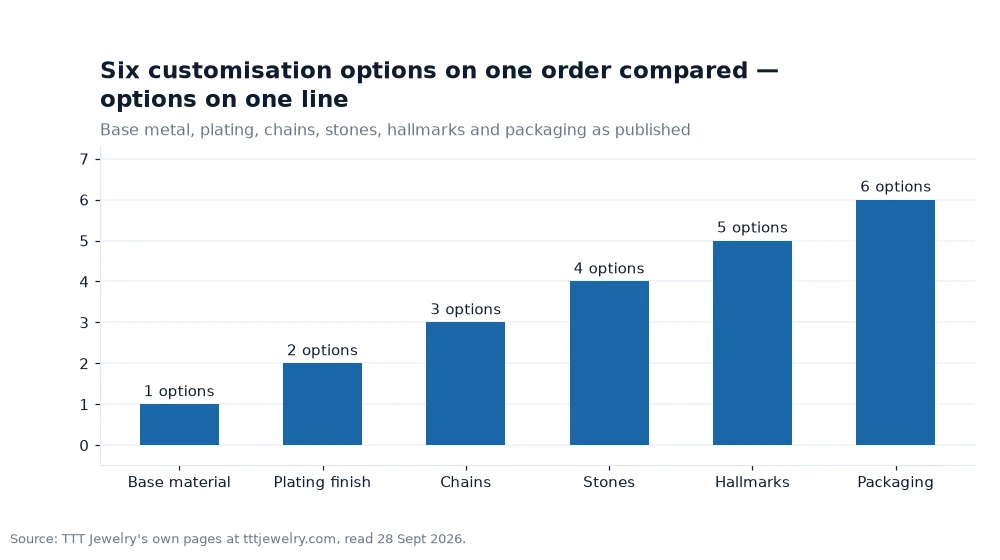
- Six customisation options can be specified or left open, which gives 2^6 = 64 possible briefs.
- A coating change after approval restarts a 25–30 day sample round.
Two deposition mechanisms, not two shades of gold
In an electroplating tank the piece is the cathode. Current passes through an electrolyte, metal ions gain electrons at the surface and build into a crystal layer. The process depends on the part conducting, on current density being even, and on the geometry allowing solution to reach the metal. Deep recesses and sharp edges receive different current, so a plater manages them by racking, agitation and time.
PVD works in a low-pressure chamber. A target material is vaporised, and the vapour condenses on the part as a thin film, often with a reactive gas added to form a ceramic-like compound. There is no electrolyte and no current path through the piece, so a complex casting does not develop the same edge-heavy distribution. The trade-off is line of sight: surfaces that face away from the target need the part to be rotated during the run.
Neither route is a paint. Both bond at the atomic or crystalline level, which is why they survive wear that would strip a lacquer. The practical question is not which is newer but which suits the metal, the geometry and the exposure the piece will meet.
Which process belongs on which metal
TTT Jewelry splits the routes by base material. Stainless steel goes to PVD vacuum plating. Silver and brass go to electrolytic tanks, where multi-layer gold and rhodium are applied, with anti-tarnish e-coating available on both to slow sulphur darkening. The split is not arbitrary: a tank process on stainless is possible in principle, but the published route for the stainless line is PVD, and that is what a buyer should expect to see on a sample sheet.
Brass is the material most often plated in colour, because it takes a heavy decorative deposit and is used for statement shapes where a warm gold tone is the point. Silver goes to rhodium for a white finish or to gold for a two-tone look. Stainless goes to PVD for a colour that has to survive water, since the film is hard and does not rely on an electrolyte reaching inside a hollow form.
316L is the stainless grade named in the published material notes, with 2–3% molybdenum and a medical-grade hypoallergenic description. 304 is the cost-effective alternative for volume, water-resistant rather than swim-proof, and vacuum-plated. The coating choice and the grade choice are usually made together, because a PVD colour on 304 and the same colour on 316L will be sampled as two separate specifications.
Price is not published, so the honest comparison is structural, and the points a buyer can verify are the ones worth tabulating.
| Point | Electrolytic plating | PVD vacuum plating |
|---|---|---|
| Driving force | Current through an electrolyte | Vaporised target in a vacuum |
| Base metals in the published menu | Silver, brass | Stainless steel |
| Colour source | Metal in the bath: 14K, 18K, 24K gold, rhodium | Target material and reactive gas |
| Coverage on complex shapes | Managed by racking and current density | Managed by rotating the part |
| Extra step in the menu | Anti-tarnish e-coat on silver and brass | None published |
| Compliance base | REACH and CA Prop 65 | REACH and CA Prop 65 |
Two rows deserve attention. The colour-source row explains why a gold tone on stainless is a coating recipe rather than a carat claim: the gold is in the target, not in a plating bath measured by karat. The coverage row explains why a hollow pendant with deep undercuts is quoted differently in the two processes; each needs its own handling, and handling is labour.
The grade notes and the coating menu are published together at www.tttjewelry.com/stainless-steel-jewelry-manufacturer/, which is the page to send a buyer who asks why stainless and brass do not share a finish line.
What the choice does to sampling
Development follows the same published rhythm in either process: an inquiry, a consultation, CAD inside 48 hours, a physical sample after 25–30 days, then bulk production of 3–4 weeks and 100% final inspection. The finish enters at the sample stage, and that is where a decision becomes expensive to reverse.
A colour change after the first sample is not a note on a file. It is a new coating run, a new set of photographs under agreed lighting, and another approval cycle. At 25–30 days per round, two rounds turn a 48–60 day programme into something closer to three months. The least costly finish decision is the one made on paper, before the mould is cut.
Surface preparation sits underneath both processes. Polishing and surface art come before plating in the eight-step factory flow, and a brushed face under a PVD film looks different from a mirror face under the same film. A brief that specifies colour but not gloss has left half the finish undefined.
Keeping a mixed-metal collection coherent
A collection that spans stainless, silver and brass will not share one coating process, but it can share one apparent colour. The way to get there is to sample the three metals in the same week, under the same light, and approve the trio as a set rather than approving each piece alone.
The custom brass jewelry route is where the tank process does most of the work, since brass carries the heavy decorative plate. Pairing a brass centrepiece with stainless findings means two finishes on one piece, and the junction between them is where a tone mismatch shows first.
Hallmarks need the same discipline. Marking is laser-engraved, the published examples are S925, 316L and 18KGP, and each one belongs to a specific metal and coating. Engraving 18KGP on a PVD-coated stainless piece is a different claim from engraving it on gold-plated brass, and the two should not be treated as interchangeable label text.
Worked example
Suppose a six-SKU collection, two designs in each metal. Silver at 2 × 50 = 100 units, brass at 2 × 100 = 200 units, stainless at 2 × 100 = 200 units, so the programme floor is 100 + 200 + 200 = 500 pieces. Stainless alone accounts for 200/500 = 40% of that commitment.
Now the specification. The six customisation options are base material, plating and finish, chains and findings, stones and accents, logo and hallmark, and packaging. If each is either pinned down or left open, the brief has 2^6 = 64 possible shapes. Leaving three open gives 2^3 = 8 variants to sample, and at 25–30 days per round those variants do not all fit in one cycle.
Calendar: 2 days of CAD, 25–30 days of sampling, 21–28 days of production. One clean pass through the three blocks lands at 48 days (2 + 25 + 21) or stretches to 60 days (2 + 30 + 28). CAD is 2/48 = 4.2% to 2/60 = 3.3% of that, so the leverage sits in the 25–30 day block, not in modelling speed.
Frequently asked questions
Can stainless steel be gold-plated in a tank instead of PVD?
The published route for the stainless line is PVD vacuum plating; tank plating in 14K, 18K or 24K gold and rhodium is listed for silver and brass, so a stainless colour request should be quoted as PVD.
Does PVD give the same colour as 18K gold plate?
Both can read as warm gold, but the colour comes from different sources — a target and gas in PVD, gold in the electrolyte for plating — so the two tones should be approved side by side on physical samples.
Which process suits a piece worn in water?
PVD on 316L is the published pairing for water exposure, because 316L carries 2–3% molybdenum and the vacuum film does not depend on a bath reaching inside the shape.
Choosing a route before the first sketch
The process decision belongs in the design brief, not in the purchase order. Once the metal, the geometry and the wear context are written down, the coating route follows: stainless to PVD, brass and silver to the tank. Reversing that order produces samples that are technically correct and commercially wrong.
A buyer who wants the two development models spelled out before committing can start with the OEM/ODM jewelry manufacturer page, which separates buyer-owned CAD from concepts the factory develops. That distinction decides who signs off the finish, and therefore who pays for a second round.
Source note: figures come from the manufacturer's own website (tttjewelry.com), read 28 Sept 2026.[1]